· updated
Postman alternatives in 2026, compared in daily use
Bruno, Yaak and Tetiva are the light local options; Tetiva installs at about 30 MB and asks for no account. Hoppscotch is the one for browser access and a shared workspace, Insomnia for maturity, plugins and an OpenAPI toolchain. Below is how the five differ in daily use.
Why developers replace Postman#
Postman is no longer just an app for sending HTTP requests. It is a broad API platform with design tools, documentation, monitors, team workspaces, and agent features. Some teams need that whole toolchain. If you mostly send requests and read responses, much of it sits unused.
There is no single best replacement; the useful choice depends on how you store collections and who edits them. Pricing and plan limits change, so confirm them before purchasing.
Two other reasons come up in most threads on the subject: the account and the analytics. Postman pushes you toward signing in and collects telemetry by default. In June 2025 it published a security update about "Related Requests", which had been sending full request URLs, variables included, to Postman's backend; the fix shipped in v11.46.5, and the feature now sends only the hostname. Bruno, Yaak and Tetiva send no telemetry.
Quick comparison#
| Postman | Insomnia | Bruno | Yaak | Hoppscotch | Tetiva | |
|---|---|---|---|---|---|---|
| Install size | ~140–160 MB | ~350–580 MB | ~100–160 MB | ~40–77 MB | Browser; desktop app too | ~30 MB |
| Account required | Encouraged; lightweight mode works without one | Scratch Pad only without an account | No | No | See docs | No; only for cloud sync |
| Telemetry by default | Yes | Yes (opt-out) | None | None | — | None |
| Protocols | HTTP, gRPC, GraphQL, WS | REST, GraphQL, gRPC, WS, SSE, SOAP | REST, GraphQL, gRPC, WS, SOAP | HTTP, GraphQL, gRPC, WS, SSE | REST, GraphQL, WS, SSE, Socket.IO, MQTT | HTTP, gRPC (unary), GraphQL, WS |
| Sync model | Cloud only | Cloud, Git Sync or local | Git and files | Git and files; no vendor cloud | Cloud workspaces; self-hosted platform | Optional cloud sync |
| License and price | Proprietary; free tier, then Solo $9 (one seat), Team $19 and Enterprise $49 per user a month, billed annually | Apache 2.0 client; free Essentials, Pro $12, Enterprise $45 per user a month, billed annually | MIT core; free edition, Pro $6, Ultimate $11 per user a month, billed annually | MIT source, paid binaries: $79 a year solo, $149 per user a year for business | MIT; free plan, Organization $6 per user a month, billed annually | MIT client; cloud free tier, paid plans |
Prices checked on 2026-08-27 against the vendors' pricing pages; install sizes from the official downloads on 2026-06-10 and vary by OS.
Sources: Postman, Insomnia, Bruno, Yaak, Hoppscotch.
What to compare before switching#
After a few days the differences come down to five things:
- Size and startup. Measure installed size and a cold launch after reboot. A second launch from the filesystem cache is a different result.
- Protocols. REST is the baseline. gRPC, GraphQL, WebSocket, SSE, and Socket.IO support can remove the need for separate utilities.
- Privacy. Find out where collections and secrets live, whether an account is required, and what analytics the app sends.
- Sync. Cloud sync is the quickest way to collaborate. Git gives you reviewable diffs; self-hosting keeps the infrastructure under your control.
- Price. Check commercial-use terms, collaborator limits, administration features, and CLI access, not only the individual free tier.
Insomnia: a mature client with storage choices#
Insomnia has been around longer than most clients here and covers more of the API workflow in one desktop app. It handles REST, GraphQL, gRPC, WebSocket, SSE, and SOAP, imports Postman and OpenAPI data, and Inso CLI brings collection tests into CI.
Its clearest advantage is storage flexibility: projects stay local, use Git Sync, or use Insomnia's cloud, and the local Scratch Pad works without signing in. Insomnia does collect analytics; its privacy policy lists Segment, Sentry, and Google Analytics among others. That is not the same as sending every request to a vendor, but a company with strict egress rules should read the documented data flow first.
The free Essentials plan covers local and cloud projects plus Git Sync, with collaboration limits. Pro is $12 per user per month and Enterprise $45, billed annually.
Bruno: collections designed for Git#
Bruno treats the filesystem and Git as the collaboration layer. Collections are text files, so a team reviews request changes in pull requests, branches them with the application code, and moves them without a hosted collection database in between. Basic local use does not require an account.
The client supports REST, GraphQL, SOAP, gRPC, and WebSocket. Paid plans add a more extensive Git interface, integrations, and organization controls: $6 per user per month for Pro and $11 for Ultimate, billed annually.
Concurrent edits become ordinary Git conflicts; there is no live shared document.
Yaak: local data and a focused desktop UI#
Yaak is an open-source, local-first client built with Tauri. It supports HTTP, GraphQL, gRPC, WebSocket, and SSE. Workspaces can be stored as plain files and synchronized through Git; no Yaak cloud holds project data.
The project explicitly advertises zero telemetry. Requests and history remain on the device, and secrets can be encrypted. The source is MIT-licensed, but the official signed binaries are free only for personal use: $79 per year for an individual, $149 per user per year for a business, and a $349 one-time individual license. The fallback license keeps the last eligible version working after a subscription ends.
Hoppscotch: web access with a self-hosting path#
Hoppscotch starts in the browser, with no installation required; desktop and CLI clients exist too. Its documented platforms cover REST, GraphQL, WebSocket, SSE, Socket.IO, and MQTT. A gRPC-heavy team should check support for its exact flow first.
The distinguishing option is self-hosting: a shared web interface and team workspaces with the deployment under your control. Hoppscotch Cloud has a free plan with unlimited workspaces, collections, and requests; the Organization plan is $6 per user per month billed annually. Switching between workspaces is documented for signed-in users (workspaces). Telemetry is documented only for self-hosted instances, a weekly ping you can switch off.
Browser access removes desktop rollout work, but browser security restrictions can complicate calls to local services. Hoppscotch addresses those cases with an agent and desktop app.
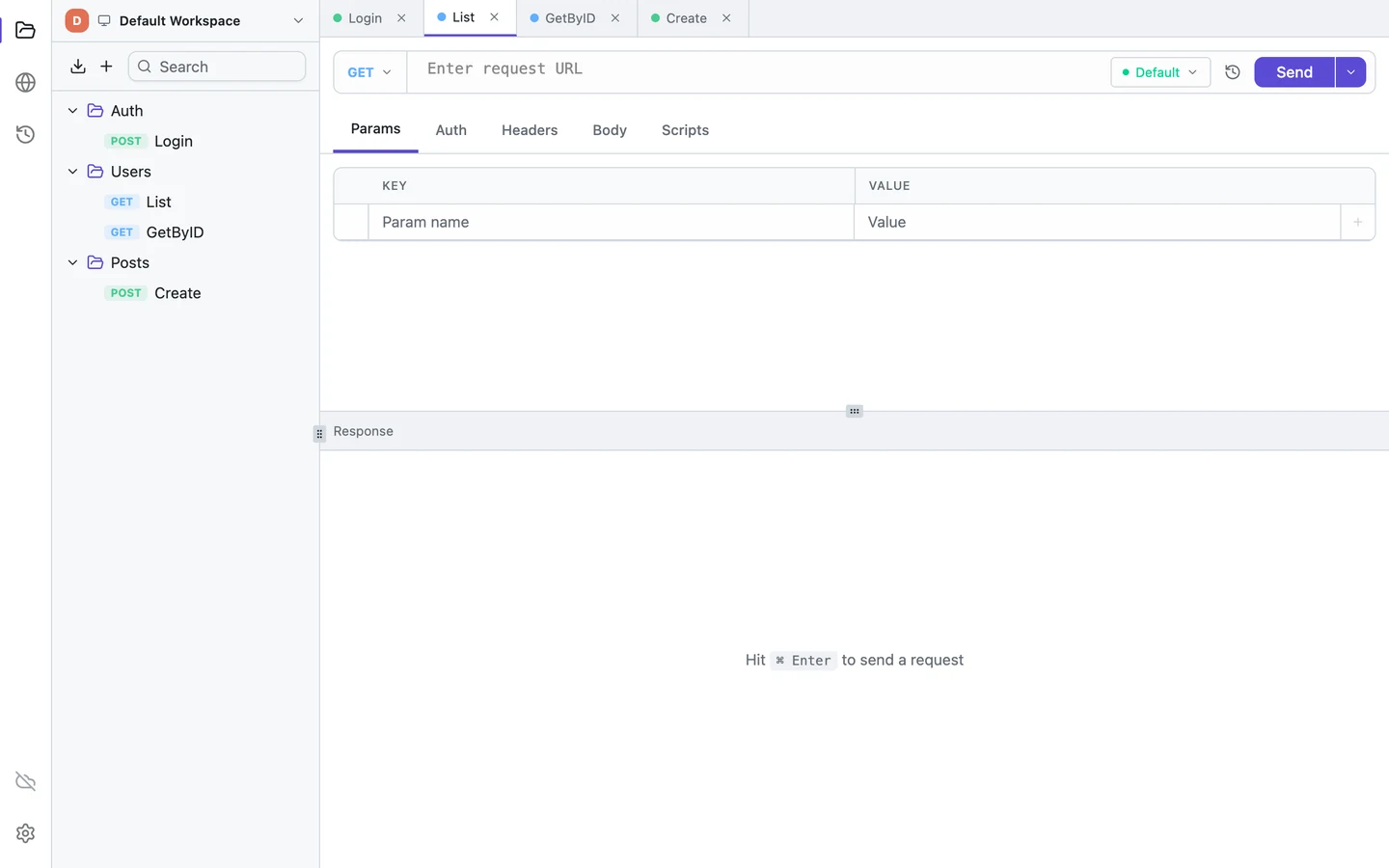
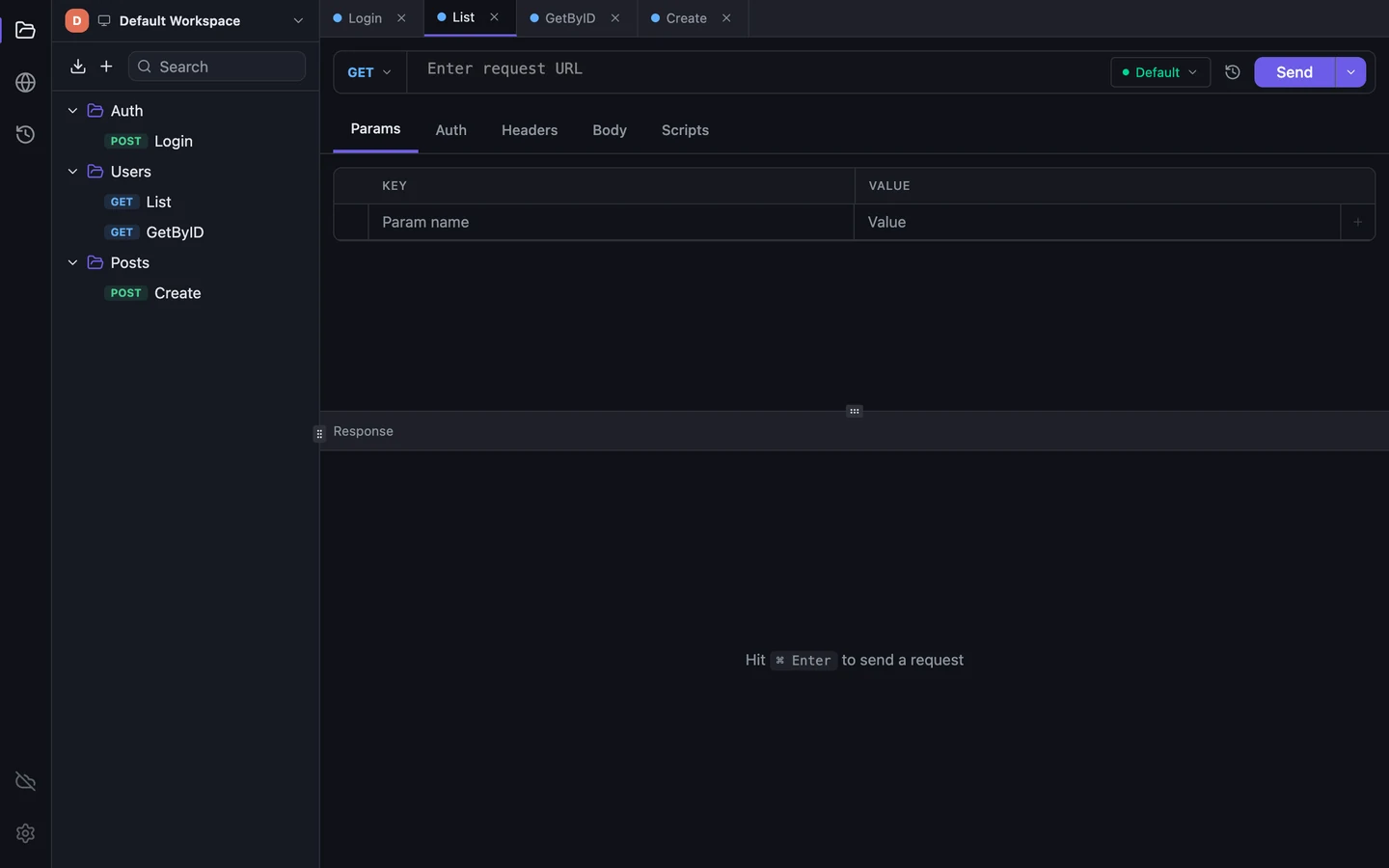
Tetiva: a 30 MB client with Postman import#
Tetiva is our own client, so weigh this section accordingly. It is an MIT-licensed desktop app for HTTP, gRPC, GraphQL and WebSocket, about 30 MB installed, with a cold start the project measures under 500 ms. Those are our figures on our machines, not a six-client benchmark.
Import is what most people try first. Export a Postman Collection v2.1 file and the folder tree, requests, headers, bodies, auth, descriptions and saved responses come across, and environments import separately. Collection variables become an environment named after the collection. Scripts come in when you tick Import scripts, but pm is only partly implemented, so expect to edit some. Files attached to form-data fields or used as binary bodies are not imported. Insomnia and Hoppscotch collections, OpenAPI specs and HAR files import too. The migration guide has the rest, and the Tetiva vs Postman page puts the two side by side.
Scripts run on goja inside a sandbox with no filesystem and no network, cut off after five seconds. The pm.* surface covers environment variables, request headers, pm.test, pm.expect with chai and the response helpers; pm.sendRequest is missing (scripting).
gRPC schemas come from server reflection or from .proto files. Only unary methods can be invoked today (streaming ones appear in the picker and refuse to run), and a grpcs:// address goes over TLS (gRPC). There is also an MCP server on 127.0.0.1:9300: an agent like Claude Code can list collections and send a saved request with your environments and scripts.
Sync is opt-in through Tetiva Cloud. There are no analytics; the only call the app makes on its own is a version check at startup. The client is free, the cloud has a free tier, and paid plans are on the pricing page.
It is a young product: import a collection you actually use and check the paths you depend on before it carries anything critical.
Which one fits which workflow#
Insomnia makes sense when API design, OpenAPI files and a CLI step in CI are part of the job. Bruno, when collections belong in pull requests next to the code that calls them. Yaak works for a quiet local setup with Git collaboration, if the per-seat binary license works for your employer. Hoppscotch, when access by URL and an on-premises deployment decide the question. Tetiva is the small desktop option with gRPC, an MCP server and sync you switch on yourself, and the youngest of the five. Staying on Postman is also an answer if monitors, mock servers and Flows are what your team runs on.
How to test an alternative with your own collection#
- Export the collection you open every day from Postman as Collection v2.1, plus each environment as its own file.
- Import it into the candidate (download Tetiva if it is on your list) and count what arrived: folders, requests, auth on those that inherited it.
- Turn off Wi-Fi and see what the app still lets you do. Cloud-only clients tell the truth here.
- Run one gRPC call against a real service: reflection first, a
.protofile if reflection is off. - Have two teammates edit the same request and reconcile it: a merge conflict, a cloud document, whatever the model is.
After an afternoon with your own collection you will know which of these limits your team actually hits.
Frequently asked questions#
Which Postman alternative is the lightest install?
Tetiva at about 30 MB, then Yaak at roughly 40–77 MB depending on the OS. Bruno is 100–160 MB, Postman 140–160 MB and Insomnia 350–580 MB, by the official downloads checked on 2026-06-10.
Which of these are open source?
Bruno (MIT), Yaak (MIT, with paid binaries for professional use), Tetiva (MIT) and Hoppscotch (MIT). Insomnia's client is open source under Apache 2.0; Postman is proprietary.
Which one works without creating an account?
Bruno and Yaak do not require one. Tetiva's desktop client does not either; you sign up only if you want Tetiva Cloud sync. Insomnia offers a local Scratch Pad without an account.